New Board Members and Honoring Regulatory Excellence at #CLEAR2026
This September, the Council on Licensure, Enforcement, and Regulation (CLEAR) gathered in Portland, Oregon for its 46th Annual Educational Conference — welcoming a new slate of Board leadership and honoring five nominees whose work redefined what regulation can do.
CLEAR 2026–27 Board of Directors
A Changing of the Guard
Announced at CLEAR's 46th Annual Educational Conference — Portland, Oregon, September 2026

- President-Elect: Mike Carpenter
- Regular Member: Christine Arnold— incumbent
- Regular Member: Jennifer Garrett— incumbent
- Regular Member: Andrew LaFratte
- Regular Member: Adam Slater
- Past President: Staci Mason
- Regular Member: Shilo Tooze
We look forward to the incoming board's leadership, experience, and continued contributions to CLEAR and the professional regulation community — and we're grateful to Staci and Shilo for their dedicated service and the lasting impact they've made. Congratulations and thank you to all!
Alongside this leadership transition, CLEAR also recognized this year's award nominees — five very different corners of professional regulation, each one a system that was failing quietly, rebuilt in the open. What follows are their citations.
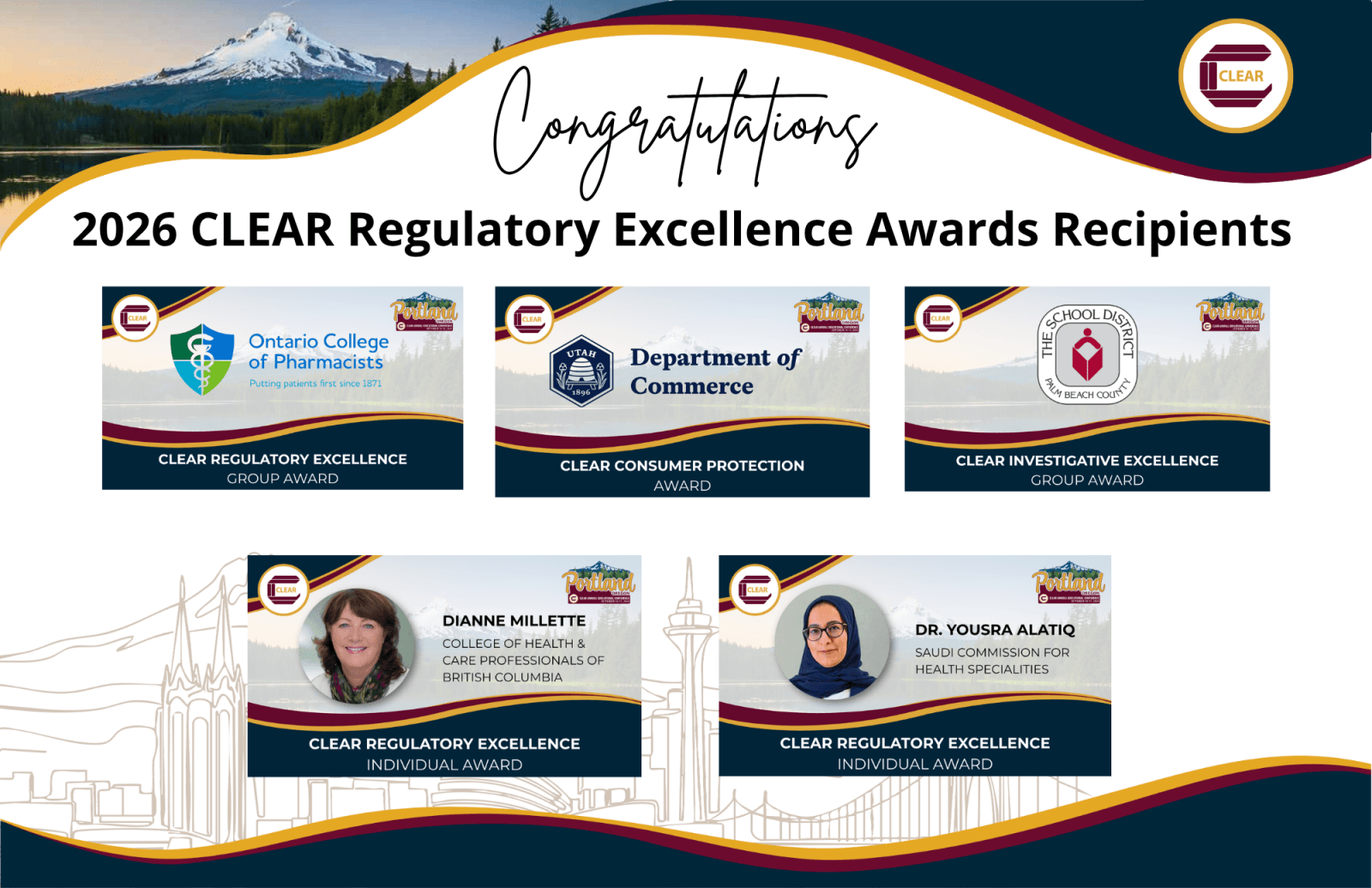
Consumer Protection Award
Utah Division of Professional Licensing & the Office of Professional Licensure Review — USA
In 2024, a routine review turned up an alarming statistic: massage therapy generated more sexual misconduct complaints than any other profession the Division of Professional Licensing (DOPL) regulates. Digging deeper, the Office of Professional Licensure Review (OPLR) found an estimated 150 to 195 illicit massage businesses operating in Utah — many functioning as fronts for human trafficking and commercial sex. Worse, fewer than a third of these businesses had records showing who actually owned them, and a patchwork of local rules let bad actors simply hop from city to city to dodge enforcement.
DOPL and OPLR's response was Utah House Bill 278 (2025), which created a statewide Massage Establishment Registry requiring:
- Mandatory state registration and municipal business licenses
- Organizational charts and criminal background checks for any owner or manager holding a 10% or greater stake
- New inspection authority to check for "unlawful conduct indicators" — locked doors meant to stall inspectors, signs that people are being housed on-site, and unlicensed practice
Crucially, the initiative redirects enforcement away from the workers — who are frequently trafficking victims themselves — and squarely onto the owners profiting from the operations. DOPL paired the crackdown with public education, launching an awareness campaign during National Human Trafficking Awareness Month and requiring registered establishments to post their registration alongside a disclosure form with anti-trafficking resources and reporting instructions.
Investigative Excellence Award — Group
School District of Palm Beach County — led by Edilia De La Vega
After the pandemic, the Office of Professional Standards (OPS) — the unit responsible for investigating ethics violations across the School District of Palm Beach County — lost decades of institutional knowledge as staff turnover hit a staggering 46%.
Rather than simply trying to rebuild what was lost, Director Edilia De La Vega used the crisis to modernize the department. Starting in Fall 2023, OPS made CLEAR's National Certificate for Investigator Training (NCIT) program mandatory for all new hires, giving a team with wildly different backgrounds — former law enforcement officers and career educators alike — a single, standardized, evidence-based investigative methodology.
- Turnover dropped from 46% to 13.3% in FY24 and 15.4% in FY25 — a 33% reduction in attrition
- Average case duration fell 60%, from 64.17 days in FY24 to 25.43 days in FY26
- Investigators began pairing standardized interview techniques with digital evidence — badge-scan data, IT logs, and real-time video
OPS also extended its training beyond its own walls, creating a district-wide program to help principals and administrators handle preliminary evidence and ethics questions themselves — freeing investigators to focus on the most complex cases.
Regulatory Excellence Award — Group
Ontario College of Pharmacists — led by Jane McKaig
In 2023, the Ontario College of Pharmacists (OCP) found that more than 20% of assessed pharmacies were failing to meet national compounding standards — a gap tied directly to serious incidents, including chemotherapy underdosing cases at four Ontario hospitals and the death of a child from a compounding error.
OCP's response was an 18-month, cross-disciplinary effort to build the Non-Sterile Compounding Supervisor Training Course, which launched on February 5, 2026. The course covers eight modules plus a final exam, and is mandatory for new non-sterile compounding supervisors and for pharmacies not meeting standards — but free and open to anyone, in any jurisdiction. It's paired with new risk-assessment tools and templates to help pharmacies properly determine and document compounding risk levels.
"The program was well designed, thorough, and effective in providing guidance, practical scenarios, and knowledge checks throughout."
Early feedback has been strong, with a 4.71-out-of-5 average rating for improving understanding of national (NAPRA) standards and OCP's own assessment criteria. As the first program of its kind in Canada, it's already being positioned as a national model for other pharmacy regulators.
Regulatory Excellence Award — Individual
Dianne Millette, College of Health and Care Professionals of British Columbia — Canada
Dianne Millette had a job most regulators never face: building an entire regulatory body from scratch. As the founding CEO and Registrar of CHCPBC — now Canada's largest multi-profession regulator — she chose the harder, more ambitious path of full amalgamation over a simpler federated model, merging multiple legacy colleges into one unified organization.
- All corporate functions and processes built for a brand-new organization
- Harmonized licensing requirements across multiple professions
- A unified intake and complaint-investigation process, including clearing a significant inherited backlog
- A new harmonized, evidence-based and risk-based quality assurance program
All of it delivered in under two years — while building consensus across professions with deeply entrenched legacy practices, recruiting an entirely new team, and navigating skepticism from licensees and fellow regulators who'd never seen anything like it attempted in Canada. Millette has since taken the lessons from this work onto the international stage, sharing CHCPBC's experience at conferences to help other regulators considering similar reforms.
Regulatory Excellence Award — Individual
Dr. Yousra Alatiq, Saudi Commission for Health Specialties — Saudi Arabia
Dr. Yousra Alatiq led a national effort to transform how Saudi Arabia reviews the qualifications of its healthcare workforce — a system covering more than 700,000 practitioners from 140 nationalities. Before the reform, qualification review was inconsistent and slow, leaving practitioners uncertain of their status and regulators without a coherent way to weigh risk.
Between 2022 and 2024, her team:
- Developed more than 100 Speciality and Specialisation Description Cards defining scope of practice, competencies, and education requirements
- Built a centralized qualifications database with structured fields for acceptance status, speciality, and equivalency
- Reviewed and governed roughly 50,000 qualifications, correcting classification errors and eliminating duplication
- Cut decision timelines from several months down to 25–50 working days
- Consulted with more than 40,000 practitioners to shape the new standards
By aligning qualification decisions with risk level, defined scope of practice, and professional equivalency, Dr. Alatiq turned what had been an administrative bottleneck into a transparent, risk-based governance function — one that regulators in other countries are now looking to as a scalable model.
A Shared Thread
Different professions, different countries, wildly different problems — but each of this year's award nominees shares something in common: they didn't settle for the regulatory status quo. Whether it was closing a loophole that let traffickers hide in plain sight, turning a staffing crisis into an opportunity, or building new systems where none existed before, these nominees show what's possible when regulators choose to lead rather than simply enforce.